
Rotator Cuff Pain vs. Shoulder Impingement: What’s the Difference?
If your shoulder aches when reaching overhead, the primary issue usually comes down to structural compression or tissue tearing. For a sharp pinch between 60 and 120 degrees of arm elevation with strength largely preserved, you are likely dealing with shoulder impingement or localized tendonitis. If you experience persistent night pain when lying on the affected arm, deep aching, and genuine motor weakness, such as your arm dropping involuntarily, you are likely facing a rotator cuff tear. Impingement responds exceptionally well to targeted conservative care, joint mobilization, and postural re-education within four to eight weeks. Full-thickness rotator cuff tears may require specialized rehabilitation or orthopaedic evaluation depending on age and activity goals.
Key Takeaways
- Shoulder impingement involves mechanical pinching of tendons, whereas a rotator cuff tear involves partial or complete structural tearing of muscle tissue or tendon fiber.
- Pain location differs: impingement typically presents at the top or side of the shoulder during overhead movement, while tears often radiate deep down the lateral arm and cause intense nocturnal discomfort.
- True muscle weakness—where the arm cannot support its own weight—strongly indicates a rotator cuff tear rather than simple impingement or tendonitis.
- Conservative care involving chiropractic adjustment, physical therapy, and soft tissue therapy successfully resolves up to 80% of impingement and tendonitis cases without surgical intervention.
- Early clinical evaluation prevents minor tendon friction from deteriorating into chronic tendinosis or full-thickness tears over time.
Understanding the Core Difference: Shoulder Impingement vs Rotator Cuff Tear
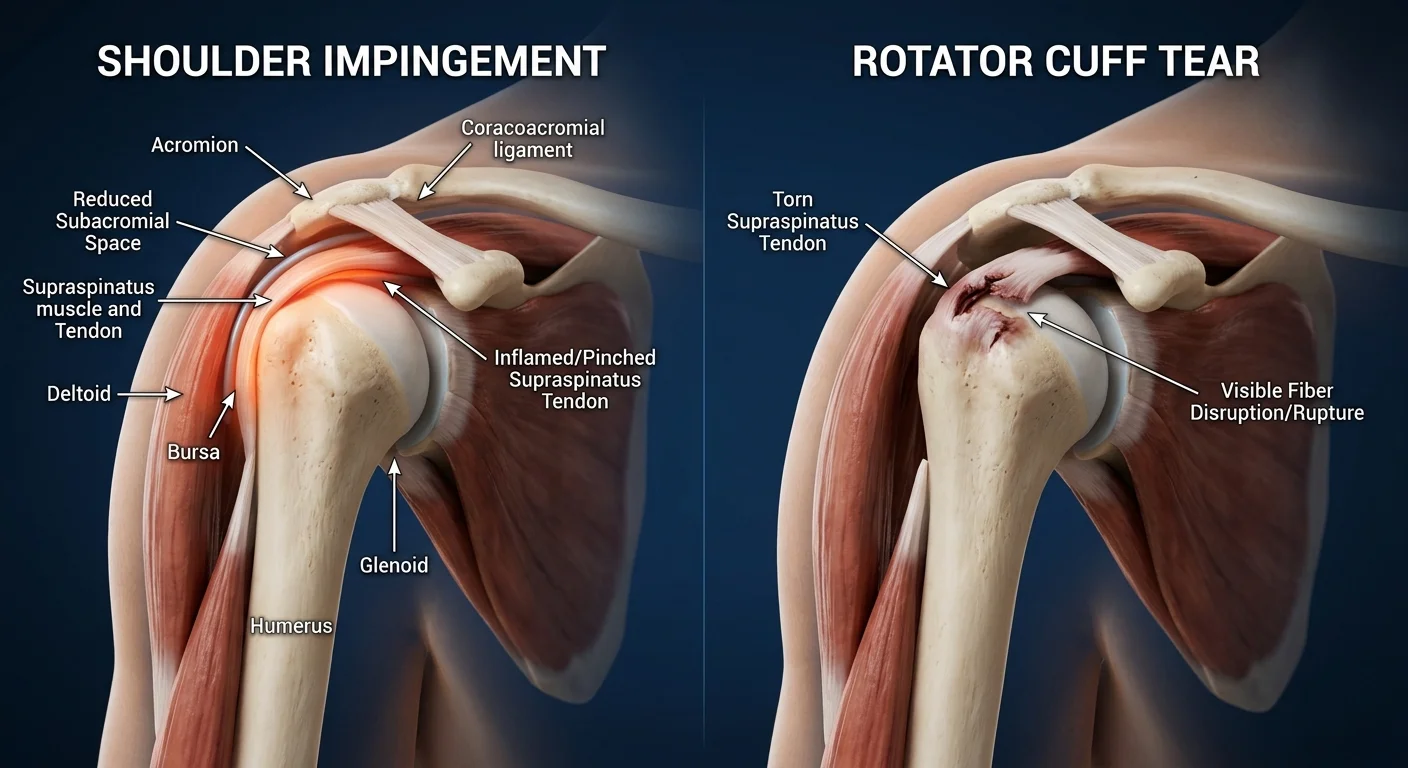
Determining the source of shoulder discomfort requires looking at whether soft tissue is being compressed or structurally disrupted. The shoulder joint is a ball-and-socket structure built for extreme mobility, which leaves it reliant on a precise web of muscles and ligaments for stability. Four specific muscles—supraspinatus, infraspinatus, teres minor, and subscapularis—form the rotator cuff. These muscles hold the head of your upper arm bone centered inside your shoulder socket while allowing broad rotation.
Shoulder impingement syndrome occurs when the space between the top bone of the shoulder, called the acromion, and the rotator cuff tendons narrows. Every time you lift your arm, the acromion pinches the subacromial bursa and the underlying tendons. According to clinical research indexed by the National Center for Biotechnology Information, shoulder impingement accounts for 44% to 65% of all shoulder pain consultations in primary care medicine. The condition functions primarily as a mechanical crowding problem rather than a broken structure.
A rotator cuff tear represents actual physical disruption of those tendinous fibers. Tears range from partial-thickness fraying on the tissue surface to full-thickness tears where the tendon completely detaches from the humerus bone. Data published by the American Academy of Orthopaedic Surgeons demonstrates that rotator cuff injuries affect nearly 30% of adults over age 60 and over 60% of individuals past age 80. While impingement creates painful friction, a tear compromises the mechanical engine that drives upper limb movement.
Difference Between Rotator Cuff Tear and Tendonitis (And How Impingement Fits In)
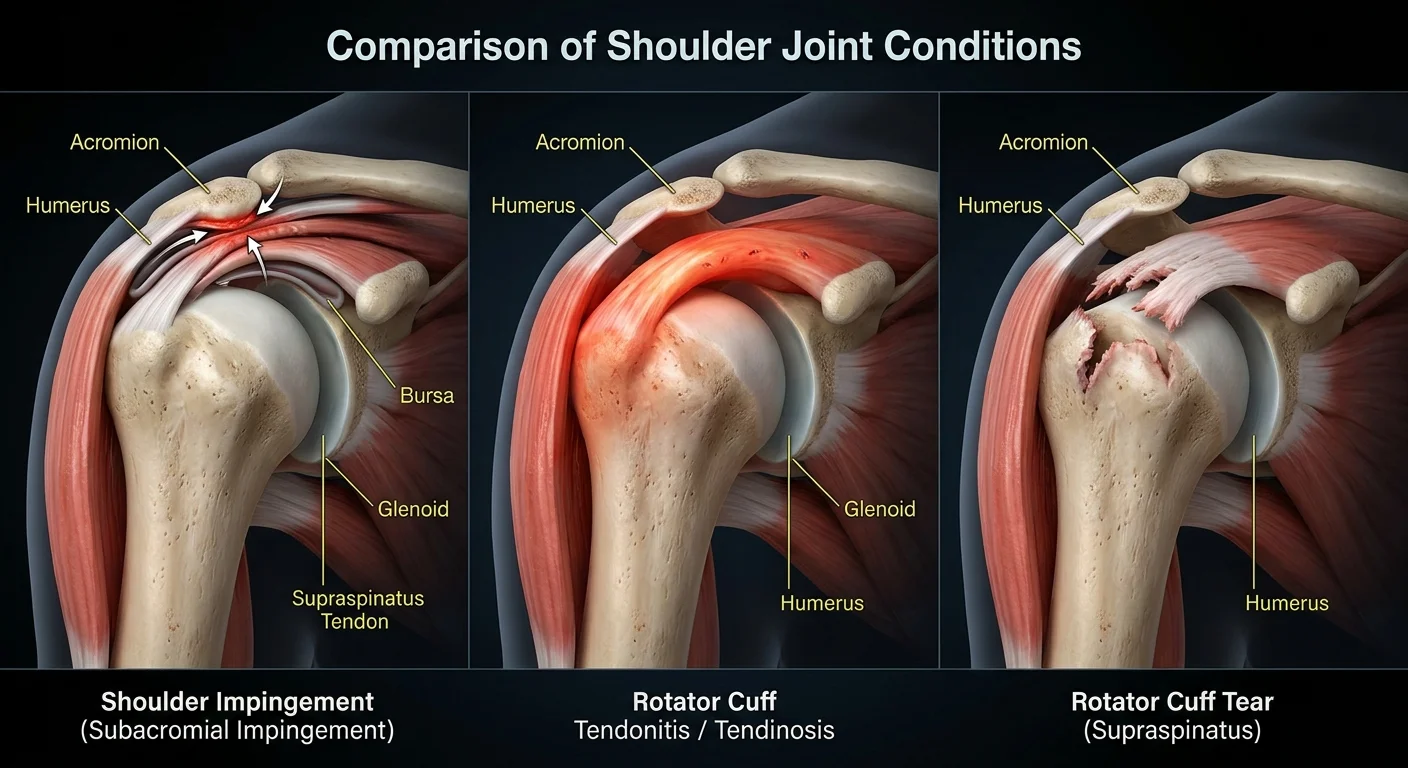
Patients often hear the terms impingement, tendonitis, and tear used interchangeably, but they mark distinctly different stages of shoulder dysfunction. Rotator cuff tendonitis describes active inflammation or micro-irritation of the tendon fibers. This condition frequently stems from acute overuse, such as weekend painting or sudden increases in swimming distance. Tendonitis is primarily a chemical and structural response to temporary overwork.
Shoulder impingement is the physical cause that frequently creates tendonitis. When poor upper-back posture or joint misalignment narrows the subacromial space, the tendon rubs continuously against bone during daily activities. Over time, continuous mechanical rubbing transforms acute tendonitis into chronic tendinosis, a state where tendon collagen breaks down and weakens. Understanding how targeted joint alignment relieves this friction is essential, as explained in our detailed guide on how chiropractic care addresses shoulder pain causes.
A rotator cuff tear is often the end stage of this progressive structural wear. Chronic friction weakens the tendon fibers over months or years until a minimal load causes them to split. Alternatively, acute trauma—such as bracing yourself during a fall or lifting a heavy object—can instantly tear a healthy or mildly inflamed tendon. The fundamental difference lies in tissue continuity: tendonitis involves inflamed but intact tissue, impingement describes mechanical crowding, and a tear means structural failure of the muscle-tendon unit.
Comparing Symptoms: Impingement Syndrome vs Rotator Cuff Tear
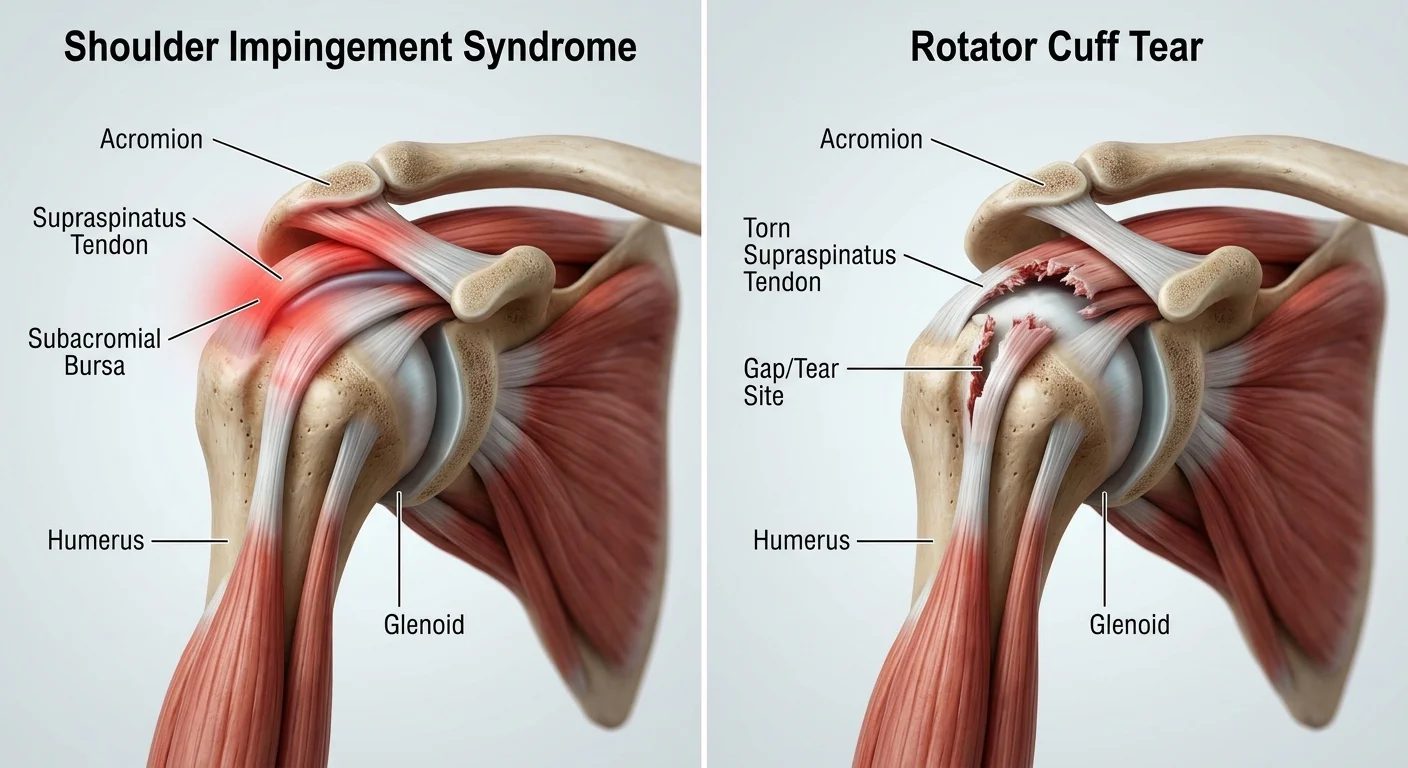
Recognizing how your shoulder behaves during everyday tasks provides immediate clues about the underlying injury. Impingement syndrome typically produces a localized, dull ache at the top or side of the shoulder joint. The pain becomes sharp and precise during what clinicians call the “painful arc”—raising the arm sideways between waist height and ear level. Outside of this middle range, shoulder pain often subsides completely.
Rotator cuff tears present with more persistent and debilitating symptoms. Tear pain frequently radiates deep into the lateral deltoid muscle, extending midway down the outer arm. A hallmark signature of a rotator cuff tear is nocturnal pain. Sleeping on the affected shoulder or lying flat can provoke intense, deep throbbing that disrupts sleep patterns consistently.
Functional strength provides another key distinction between these conditions. With impingement or mild tendonitis, any sensation of arm weakness is usually caused by pain guarding; once the pain subsides, full muscular power remains intact. With a structural rotator cuff tear, genuine motor weakness occurs regardless of pain levels. You may find it physically impossible to maintain your arm in an elevated position against mild downward pressure.
To help evaluate your functional movements at home, watch for these four diagnostic movement patterns:
- The Painful Arc Test: Slowly raise your arm straight out to the side. Sharp pain between 60 degrees and 120 degrees that clears near the top signals impingement.
- The Drop Arm Sign: Lift your arm sideways to shoulder height and try lowering it slowly. If your arm drops suddenly due to lack of control, a rotator cuff tear is highly likely.
- The Internal Rotation Reach: Reach behind your lower back to touch your opposite shoulder blade. Sharp restriction near the belt line typically points toward impingement and bursitis.
- The External Rotation Lag: Bend your elbow to 90 degrees and rotate your forearm outward against light pressure. Inability to hold position indicates potential infraspinatus tearing.
Comparison of Shoulder Conditions
The table below summarizes the key differences in cause, symptoms, functional limits, and general management across common shoulder pathologies.
| Condition | Primary Cause | Key Symptoms | Functional Mobility | Typical Care & Cost Range |
|---|---|---|---|---|
| Shoulder Impingement | Narrowing of subacromial space; repetitive overhead use. | Pinching pain during arm elevation between 60° and 120°. | Full strength preserved; painful mid-range movement. | Conservative care / PT ($60–$200/session; 4–8 weeks). |
| Rotator Cuff Tendonitis | Acute overuse; localized tendon inflammation. | Dull ache after activity; tenderness on shoulder front. | Mild restriction from pain; no true structural loss. | Rest, physical therapy, soft tissue ($50–$180/session; 2–6 weeks). |
| Partial Rotator Cuff Tear | Fraying of tendon from chronic wear or minor trauma. | Deep shoulder ache; moderate night pain; intermittent catching. | Partial weakness when holding arm away from body. | Rehab, chiropractic, regenerative options ($500–$3,000 conservative). |
| Full-Thickness Tear | Complete detachment of tendon from bone structure. | Severe radiating pain; intense night pain; arm drops down. | Inability to lift or support arm against gravity. | Surgical consultation, extensive physical therapy ($10,000–$35,000+ total). |
Diagnostic Tests and Clinical Evaluations for Impingement and Tears
Accurate clinical evaluation begins with hands-on orthopaedic testing conducted by an experienced healthcare professional. During a physical exam, your provider performs validated physical maneuvers to isolate specific structures. The Hawkins-Kennedy test pushes the arm into forward flexion and internal rotation to reproduce subacromial impingement pain. The Neer test elevates the arm straight up while stabilizing the shoulder blade to compress irritated tissue against the acromion.
When physical tests suggest significant structural damage, diagnostic imaging helps verify the depth of the injury. Standard X-rays cannot show soft tendons directly, but they reveal critical skeletal details like acromial bone spurs, joint space narrowing, or calcific deposits. Diagnostic ultrasound offers real-time visualization of tendon movement and partial fraying at a lower cost than advanced scans.
Magnetic Resonance Imaging (MRI) remains the gold standard for definitive shoulder assessment. An MRI clearly differentiates complete tendon detachment from focal tendinosis and measures muscle belly retraction. In health systems across North America, conservative care sessions cost between $60 and $250 per visit, whereas MRI diagnostics average $400 to $2,500 depending on facility type and insurance coverage.
A common professional mistake in clinical practice is assuming that motor weakness during an initial exam proves a complete structural tear. Severe pain often causes “painful inhibition,” a reflex where the nervous system shuts down muscle activation to protect the joint. Experienced practitioners clear joint restrictions and resolve acute pain first before making a final determination about structural continuity.
Treatment Options: Conservative Care vs. Surgical Intervention
Modern management protocols prioritize non-invasive conservative care for shoulder impingement, tendonitis, and partial-thickness tears. Restoring proper thoracic spine mobility and stabilizing the shoulder blade are critical steps in expanding the subacromial space naturally. When posture improves and joint mechanics normalize, compressed tissues heal without requiring invasive procedures.
Comprehensive rehabilitation utilizes targeted therapeutic modalities to reduce inflammation and rebuild functional movement patterns. Soft tissue therapies, dry needling, active release techniques, and custom exercises correct muscle imbalances between the chest and upper back. If you are struggling with persistent overhead stiffness, working with a qualified chiropractor for shoulder pain ensures proper scapulothoracic alignment and joint decompression.
Combining multiple non-invasive therapies often accelerates overall tissue healing. Integrating structured physical exercises with spinal and extremity adjustments helps rebuild endurance while protecting healing tendons. You can explore how these modalities support faster recovery in our article on combining chiropractic care and physical therapy for injury recovery.
Surgical intervention is generally reserved for full-thickness tears in active individuals, acute traumatic ruptures, or cases where six months of structured conservative care fails to restore function. According to long-term clinical data from the British Medical Journal, conservative physical rehabilitation yields equivalent 2-year functional outcomes compared to arthroscopic subacromial decompression surgery for uncomplicated impingement syndrome. This makes high-quality conservative care the recommended first-line approach.
Preventing Shoulder Injuries and Managing Daily Load
Preventing recurrent shoulder impingement or preventing tendonitis from developing into a tear requires managing daily movement habits. Modern sedentary routines push the head and shoulders forward, which tilts the scapula forward and reduces subacromial clearance. Correcting daily posture restores essential mechanical margin inside the joint.
Incorporate targeted upper-body conditioning into your regular exercise routine. Strengthening the lower trapezius, rhomboids, and external rotator muscles balances dominant chest muscles like the pectoralis major. Always warm up shoulder joints thoroughly before overhead weightlifting, swimming, or racquet sports.
Avoid carrying heavy loads with extended arms far from your torso, as this significantly increases leverage demands on the supraspinatus tendon. If your work requires repetitive overhead reaching, take brief micro-breaks every 45 minutes to perform shoulder blade squeezes and chest stretches to preserve joint space.
FAQ
What is the fastest way to tell if you tore your rotator cuff?
The fastest functional test is the drop arm test: raise your arm out to the side to shoulder height and attempt to lower it slowly. If your arm falls uncontrollably due to weakness rather than sharp pain, a rotator cuff tear is highly probable. Prompt clinical evaluation confirms structural integrity.
Can shoulder impingement turn into a rotator cuff tear?
Yes, unaddressed chronic shoulder impingement can eventually lead to a rotator cuff tear. Continuous friction of the tendon against bone causes micro-wear, leading to tendinosis, structural weakening, and eventually partial or full tearing under normal loads.
How long does it take for shoulder impingement to heal without surgery?
Most uncomplicated shoulder impingement cases resolve within four to eight weeks of consistent conservative care. Recovery relies on correcting posture, performing targeted rotator cuff exercises, avoiding aggravating movements, and restoring proper joint mechanics.
Is heat or ice better for rotator cuff pain and impingement?
Ice is best during the first 48 hours of acute flare-ups or immediately after painful activity to diminish localized swelling. Heat works better for chronic tightness, helping relax guarded surrounding muscles prior to performing daily rehabilitation exercises.
Can a chiropractor help with a torn rotator cuff?
A chiropractor can assist with partial rotator cuff tears and impingement by restoring joint mechanics, improving thoracic posture, and optimizing scapular tracking. For complete full-thickness structural tears, chiropractors co-manage care alongside orthopaedic specialists to support pre- and post-surgical rehabilitation.
Which shoulder condition causes pain while sleeping on your side?
Rotator cuff tears and subacromial bursitis are the primary causes of severe night pain when sleeping on the affected side. Direct lateral compression increases intra-articular pressure, aggravating inflamed tissue and torn tendon fibers.